Time Management for Dentists: Plan Calmer, More Focused Days
Running behind is rarely a character flaw. These six simple habits help dentists find where the day really goes, protect focused time and stay composed when the list slips.

On this page (9)
In short
- A late-running day is usually a system problem, so study the system before blaming yourself.
- One week of honest notes shows where your time actually goes.
- Short, regular blocks protect the desk work that otherwise follows you home.
- A prepared script makes running late easier for you, the team and patients.
Good time management for dentists has very little to do with moving faster. If you have ever eaten lunch over your keyboard, finished notes at home and still felt behind, you already know that effort alone does not fix a crowded day. The useful question is not how to squeeze in more, but how the day is built.
This guide looks at time management for dentists the way an engineer looks at a bottleneck. No blame, just curiosity. The six habits below are small enough to test in an ordinary week, and you can drop whichever ones do not suit your workplace.
Running Late Is Usually a System Problem
Most dentists take a slipping schedule personally. It feels like proof that you are disorganised or too slow. Yet that story is often unfair, and it stops you looking for the real cause.
Writing in Dental Economics, practice consultant Cathy Jameson described running behind as the biggest scheduling complaint her firm heard from dental practices. She also argued that while some delays are unavoidable, many are preventable because they come from the way the schedule is set up. The article is an older one, but the idea has aged well.
That is a hopeful way to see time management for dentists. A system can be studied, adjusted and tested again. Your personality does not need to change for your Thursday afternoon to improve.
$19.00 · Instant download
Habit 1: Map One Honest Week
Before changing anything, treat time management for dentists as a fact-finding exercise and see what is really happening. For five working days, keep a simple note of when you start, when you finish and what pulled you away in between. Do not tidy it up or judge it.
- Which appointment types regularly overrun?
- What time of day does the list usually start to slip?
- Who or what interrupts you most often?
- How much desk work do you take home, and on which days?
Patterns tend to appear quickly. You may find that the trouble is not the whole day but one predictable stretch. That gives you something specific to discuss with your team, and it replaces a vague feeling of being busy with facts.
Habit 2: Use the Huddle to Spot the Pinch Points
A morning huddle is one of the simplest tools in time management for dentists, and it does not need to be long. Its job is to look at the day ahead together and agree where it is likely to get tight. Five focused minutes can save a lot of hurried corridor conversations later.
Try three questions. Where will we feel squeezed today? Who might need extra help? What do we need to have ready before lunch? When everyone sees the same picture, the day stops being something that happens to you and becomes something the team is steering. Our article on dental team collaboration covers clearer handoffs in more detail.

$19.00 · Instant download
Habit 3: Give Desk Work a Home
Notes, emails, reports and staff questions have to go somewhere. Without a planned place in the day, they drift into lunch, then into your evening. Time management for dentists often improves most when this invisible work finally appears on the calendar.
Start small. Protect one or two short blocks a week and treat them like real appointments. If you are an associate, this may mean a friendly conversation with the practice owner about what is possible. If you own the practice, it means respecting your own blocks when someone asks you to fit in just one more thing.
Habit 4: Batch the Little Interruptions
Interruptions are a quiet problem in time management for dentists. A quick question is rarely quick once you count the time needed to get back to what you were doing. You cannot remove every interruption from a busy clinic, and some will always matter. Many, however, can wait an hour.
Agree a simple rule with the team about what counts as urgent and what can be saved for a set moment. A shared list works well. Staff add non-urgent questions, and you answer them together at the end of the morning.
- Check messages at two or three set times instead of between every patient.
- Silence notifications on your phone during focused blocks.
- Ask for questions to arrive with a suggested answer whenever possible.
If you find yourself answering everything because it is faster than explaining, our guide to delegation for dentists is a useful next read.
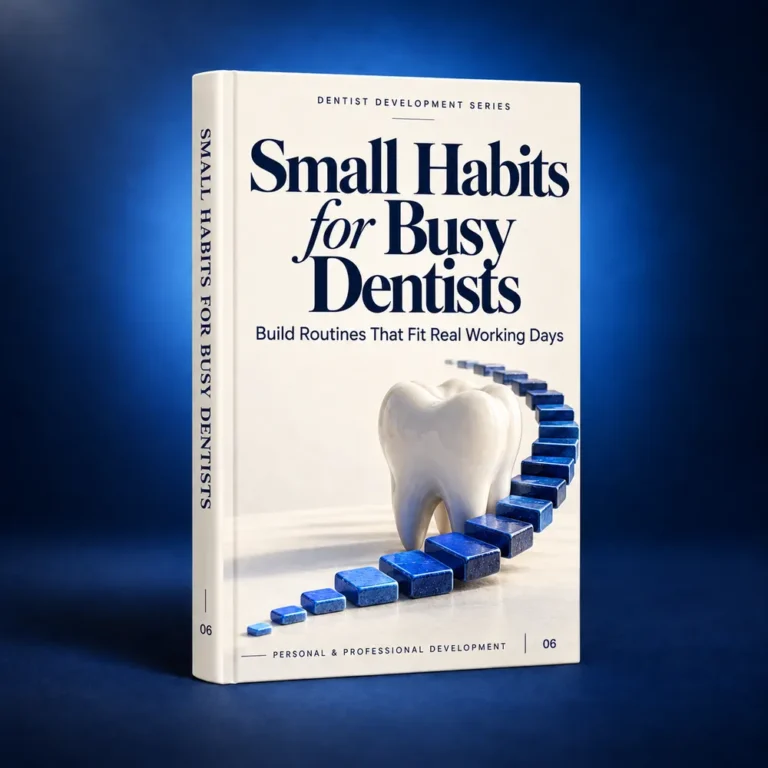
Small Habits for Busy Dentists
$19.00 · Instant download
Habit 5: Keep a Running-Late Script
Even a well-built day will slip sometimes, and solid time management for dentists includes a plan for that. What matters then is how calmly you respond. Stress makes people go quiet or over-explain, so decide on your words in advance.
Agree with reception how delays will be communicated, and at what point. Patients generally cope better with honest information than with an unexplained wait. A short, plain line is enough: “We are running about twenty minutes behind today. I am sorry about that, and I want to give you proper time when you come through.”
Then let the delay go. Rushing through the next conversation to win back five minutes usually creates a new problem. A script gives you a way to be straightforward without feeling guilty all afternoon.
Habit 6: Close the Day on Purpose
The last minutes count too, because time management for dentists does not stop at the final appointment. Many dentists never really finish work. They simply stop, with loose ends still circling. A short closing routine gives your brain a clear signal that the day is over.
Take five minutes before you leave. Write down anything unfinished, choose your first task for tomorrow, and look briefly at tomorrow’s list so nothing surprises you. Then close the laptop. This pairs naturally with the ideas in our guide to work-life balance for dentists.
Make Time Management for Dentists a Team Experiment
New habits fail when they are announced as rules. They last longer when they are offered as a test. Try one change for two weeks, ask the team what helped and what got in the way, and then keep it, adjust it or bin it.
When you start on time management for dentists, choose only one or two habits. Changing everything at once makes it impossible to tell what worked, and it tends to wear people out. Slow, boring adjustments are usually what stick.
If a heavy workload keeps weighing on you despite these changes, it may help to talk it through with a trusted colleague or a qualified professional. No planning system can solve everything, and you do not need to treat that as a personal failure. For a gentler start with routines, Small Habits for Busy Dentists looks at building routines that fit real working days.
Your Next Step: Map One Week
Pick a week, keep your notes and look for one pattern worth changing. That single step will teach you more about time management for dentists than any productivity app.
If you would like a companion for the planning side, explore The Focused Dental Day: Practical Planning for Busy Dentists, our PDF ebook on building calmer, more deliberate working days.
Continue learning
All Dentist Development eBooks resources
$19.00

$19.00