Public Speaking for Dentists: From Team Huddle to Conference Stage
Presenting to your team, a study club or a conference room calls for the same few skills. This guide shows how to find one clear message, rehearse out loud and work with your nerves before you stand up.
On this page (11)
In short
- Decide on one sentence you want the audience to remember, and build around it.
- Rehearse out loud, on your feet, and time yourself.
- Arrive early, test the equipment and carry a backup.
- Climb gradually from small rooms to bigger ones.
Public speaking for dentists rarely involves a spotlight and a huge stage. More often it means explaining a new system at a team meeting, giving a short talk at a study club or saying a few words at a colleague’s leaving party. The room may be small, but your stomach can still turn over. This guide covers six ways to prepare, whatever the size of the audience.
You already speak in public more than you think
Many dentists say they do not do any public speaking, then describe a working week full of it. You lead a huddle, you brief a new starter and you explain a change of hours to the whole team. Each of these has a message, an audience and a moment when eyes turn to you.
That is good news, because public speaking for dentists can be practised without waiting for an invitation to present. Every small occasion is a chance to try one thing, such as a clearer opening or a slower pace. The skills transfer upwards when a bigger opportunity arrives.
$19.00 · Instant download
Nerves are normal in public speaking for dentists, so plan around them
Please do not wait until the nerves disappear. Curtin University’s study guide notes that fear of public speaking is among the most common social fears, and it treats nerves as manageable through preparation and practice. That framing is helpful, because it gives you something to do.
Being skilled in one setting offers no protection in another. Someone who is steady all day at work can still dread five minutes behind a lectern, and there is nothing odd about that. Public speaking for dentists uses a different muscle, and it responds to training like any other. The six ways below are that training.
Public speaking for dentists starts with one message
The first way is to decide what your talk is for. Before you open any slides, finish this sentence: “If people remember only one thing, I want it to be…” When you have that line, everything else becomes easier to judge. Each story or slide either supports it or gets cut.
Speakers who skip this step tend to pack in everything they know. The audience then has to work out what mattered, and most will not bother. Saying less, and saying it clearly, is usually a sign of respect for the people listening.
Better Conversations in Dentistry
$19.00 · Instant download
Know who is in the room
The second way to improve public speaking for dentists is to pitch your talk at the right level for your listeners. Curtin’s guide makes this point too, adding that it helps you feel more at ease. Ask the organiser who is coming, what they already know and why they are attending.
- Your own team wants to know what changes for them on Monday.
- Fellow dentists at a study club want something they have not heard before.
- A school group or community audience needs everyday language and no jargon.
A useful test is to imagine one real person from that audience and write for them. If a word would make them frown, swap it for a simpler one.
Build a simple three-part structure
The third way is to give people a shape they can follow. Audiences can only listen once, and they cannot flick back a page. A plain structure works for almost any public speaking for dentists, from huddles to conferences:
- Opening: a brief question or situation, then your one message.
- Middle: two or three points, each with an example.
- Close: your message again, and what you would like people to do next.
Write your first and last two sentences word for word, because those are the moments when nerves tend to be strongest. Keep slides light, with few words and large type. They are there to support you, so try not to read from them.
Difficult Conversations, Clearer Outcomes
$19.00 · Instant download
Rehearse out loud, on your feet
The fourth way to sharpen public speaking for dentists is real rehearsal. Reading your notes silently at a desk will fool you, because a talk in your head always runs smoothly. Stand up and say it aloud, including the awkward parts.
Try these approaches from the Curtin guide, in rising order of discomfort:
- Rehearse until you rarely need your notes.
- Time yourself, and aim to run slightly short so there is room for questions.
- Present to a friend or family member and ask them to put questions to you.
- Film yourself and watch your expression, tone, body language and pace.
Yes, watching yourself is uncomfortable. It is also the fastest way to spot a habit you did not know you had, such as swaying or saying “so” at the start of every sentence.
Check the room and the technology
The fifth way is to remove avoidable surprises. Arrive early enough to see the room, try the clicker and stand where you will be speaking. Keep a backup of your slides on a USB stick, and carry palm cards in case the projector gives up.
For online talks, learn the platform beforehand, check that your slides work and turn off notifications. Small checks like these free up your attention for the people in front of you.
Slow down when you begin
The sixth way to steady public speaking for dentists happens on the day. Nervous speakers tend to speed up, so remind yourself to go slower than feels natural. Stand tall, relax your shoulders and take a steady breath before you say your first word.
Then use pauses on purpose. A second of silence after an important point feels long to you and normal to the audience, and it gives them time to take it in. Looking at one person for each sentence also makes a large room feel smaller. Our piece on building confidence explores this steadier kind of presence in other settings.
Handling questions without panic
In public speaking for dentists, many people fear the questions more than the talk. Prepare by listing the five you would least like to hear, then practise short answers. It helps to repeat each question aloud, so that everybody hears it and you gain a few seconds.
“I don’t know, but I’ll find out and let you know” is a perfectly good answer. Just make sure you follow up. If someone wants a long discussion, offer to continue afterwards so the session can move on.
Climb the speaking ladder one rung at a time
Progress in public speaking for dentists comes from gradually larger rooms. There is no need to jump straight to a conference. Pick the next rung and stay there until it feels ordinary:
- Lead a short slot at your team meeting.
- Share something useful at a study club or local society.
- Visit a school or community group.
- Offer a short talk at a regional event.
Each talk also introduces you to new people, so our guide to networking pairs well with this. When you need a speaker biography, Your Professional Voice is an ebook on that wider theme. If fear of speaking is seriously limiting your life or work, a qualified professional can offer support.
Your next step: volunteer for five minutes
Choose a small slot at your next team meeting and write your one message today. Then rehearse it aloud twice. If you would like a fuller companion for the road ahead, Present with Clarity is our ebook on public speaking for dentists and other dental professionals.
Continue learning
All Communication Skills resources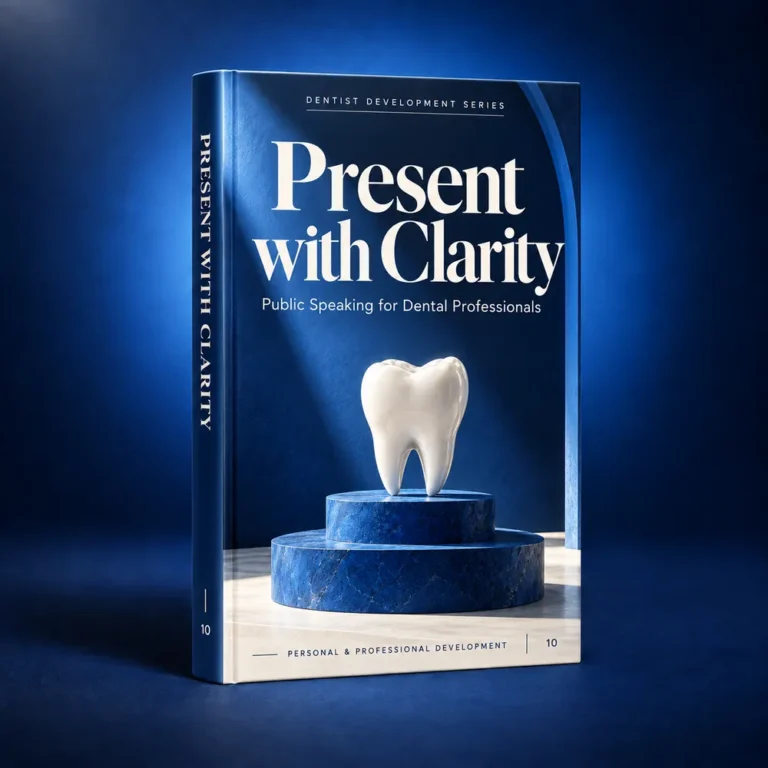
$19.00
$19.00