Emotional Intelligence for Dentists: Notice It, Name It, Then Respond
A snapped reply at the front desk usually starts as a feeling you did not catch in time. This guide offers four workable skills for spotting your reactions early and choosing how you respond at work.

On this page (10)
In short
- A reaction happens to you, while a response is something you choose.
- Precise words for feelings, such as "rushed" or "embarrassed", give you more options than "stressed".
- A short holding phrase can buy the few seconds you need.
- Reading other people works best as a question, not an assumption.
Emotional intelligence for dentists is the everyday skill of noticing what you feel, understanding it and deciding what to do next. Picture a receptionist telling you that someone at the desk is unhappy about their wait, just as you learn the next appointment has arrived early. Something rises in your chest and your sentences get shorter. What happens in the following few seconds can shape the rest of your afternoon.
The small gap between reaction and response
A reaction arrives without asking. You feel irritated, defensive or flat before you have had a single thought about it, and there is nothing wrong with that. Feelings are information about what matters to you and what seems to be under threat.
A response is different, because you get a say in it. Between the feeling and the words sits a small gap, sometimes only a second or two long. Most of the work of emotional intelligence for dentists is about finding that gap and making it slightly wider.
Emotional intelligence for dentists does not ask you to be unbothered. A dentist who feels nothing is not the goal, and neither is a dentist who smiles through everything. The aim is to have feelings without being steered by them.
$19.00 · Instant download
Why emotional intelligence for dentists keeps coming up in dental education
Researchers have started paying attention to this. A 2022 scoping review in Dentistry Journal brought together 24 studies on emotional intelligence, academic performance and stress among dental students. Its authors suggested including this kind of training in the dental curriculum.
Those findings concern students, so they cannot tell us what will happen in your particular practice. They do show that the subject is taken seriously by people who teach dentistry. Hand skills get plenty of attention in training, while handling a tense room is something many people pick up as they go, which is why emotional intelligence for dentists often has to be learned on the job.
Four skills of emotional intelligence for dentists
The rest of this guide breaks the idea into four skills: notice, name, pause and choose. They run in that order, and each one makes the next easier. You can practise them during an ordinary day, without extra time or anyone else knowing.
$19.00 · Instant download
Notice: catch the first signs
Your reactions usually show up as small physical and behavioural changes before they turn into words. Because these signals are personal, emotional intelligence for dentists begins with learning your own. Common ones include:
- Speaking faster or more quietly than usual
- Giving one-word answers to your nurse
- Tightness in your shoulders or jaw
- Avoiding eye contact with a particular colleague
- Rereading the same line on the screen
Pick a single signal and watch for it this week. There is nothing to fix yet. Just say to yourself, “there it is,” whenever it appears.
Name: find the exact word
“Stressed” is a large and blurry word. It could mean rushed, worried, embarrassed, resentful or disappointed, and each of those points somewhere different. Rushed needs a plan for the next hour. Resentful might need a conversation you have been putting off.
Try giving your feeling a more specific name, silently, when you notice it. You will not always get it right, and that is fine. The search for the word pulls your attention away from the trigger and towards what is actually going on, which is often enough to steady your thinking.
A simple way to build the vocabulary is a brief check at the end of the day. Think of the moment that stayed with you most and find three words that might describe how you felt. Then circle the closest one. After a couple of weeks, you will probably find the right word arrives faster when it counts.
$19.00 · Instant download
Pause: buy yourself a few seconds
Pausing can feel like the hardest part of emotional intelligence for dentists when someone is waiting for an answer, so prepare a few phrases in advance. They should sound natural in your voice and commit you to nothing:
- “Let me check on that and come back to you in a few minutes.”
- “I want to answer that properly. Can we talk at lunch?”
- “Give me a moment to think about that.”
- “Tell me a bit more about what happened.”
The last phrase is especially useful, because it gives you time while also showing interest. If you feel a sharp email forming, the same principle applies. Write it, leave it unsent and read it again after your next appointment.
Choose: decide what you want to happen
Once you have your few seconds, emotional intelligence for dentists comes down to one question: what do I want this person to know or feel when we finish? That shifts you from defending yourself to aiming at an outcome. With an upset person at the desk, you may want them to feel heard before anything is explained.
Sometimes the right choice is to say nothing now and pick a better time. Sometimes it is to say honestly, “I was short with you earlier and that was not fair.” A brief repair like this shows respect, and you can use the moment later as material for structured reflection.
Reading the people around you
So far the focus has been inward, yet the same attention can turn outward. A nurse who has stopped chatting or an associate who agrees too quickly may be telling you something. The other half of emotional intelligence for dentists is picking up these signals without jumping to conclusions.
Treat what you notice as a question, not a fact. “You seem a bit quiet today, is everything all right?” leaves the other person free to answer or not. When a talk needs more than that, our guide to difficult conversations and the ebook Better Conversations in Dentistry are useful next reads.
Timing and place matter here too. A question asked in a corridor between appointments may get a polite “I’m fine”, while the same question over a coffee after work may get the real answer. Give people a little privacy and some time, and be ready to accept that they may not want to talk.
Three moments to practise on this week
Skills like these grow through repetition in low-stakes situations, so do not wait for a crisis. These common moments make good practice ground:
- The running-late afternoon. Notice how you speak to your team when the schedule slips.
- The associate meeting. Name what you feel before someone raises a sensitive subject.
- The end of the day. Check what you are carrying home, and ask whether it belongs there.
Emotional intelligence for dentists has limits, of course. Noticing your feelings will not fix an unreasonable workload or a difficult workplace, and those may need practical changes. If low mood, worry or exhaustion stays with you, please speak to a qualified professional.
Your next step: pick one signal to watch
Choose your most reliable early sign and one holding phrase, then try them both before the week is out. To keep building on these ideas, The Emotionally Aware Dentist is our ebook on noticing reactions and choosing your response, and it is a good companion for anyone working on emotional intelligence for dentists in daily practice.
Continue learning
All Confidence & Mindset resources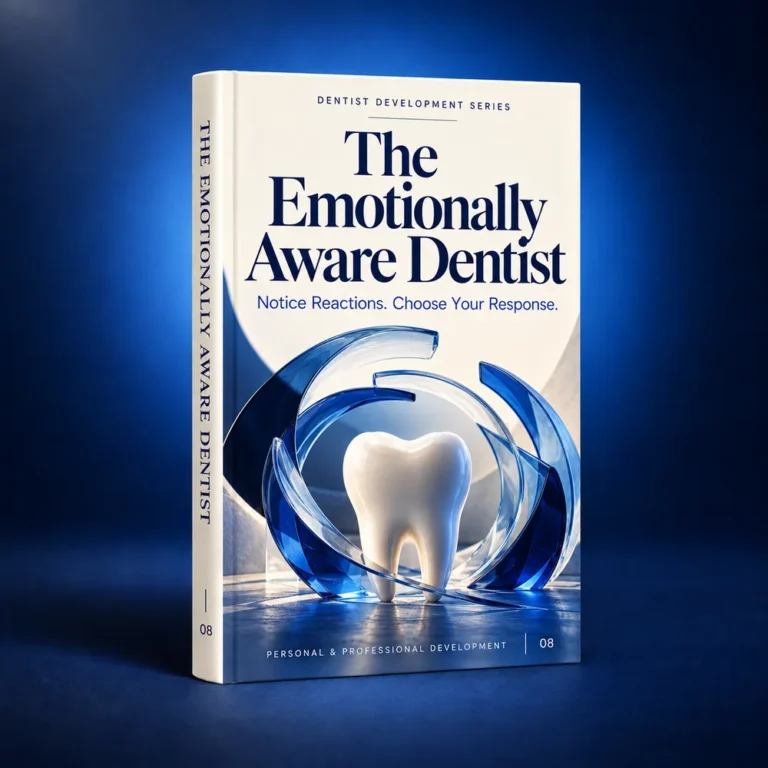
$19.00
$19.00